Classics of Marxism: Difference between revisions
Saul Wenger (talk | contribs) m (→Maoist) |
Saula Wenger (talk | contribs) |
||
| (16 intermediate revisions by 3 users not shown) | |||
| Line 1: | Line 1: | ||
[[File: | [[File:MLM heads.png|thumb|471x471px|Depiction of the six heads of [[Marxism]], [[Karl Marx|Marx]], [[Friedrich Engels|Engels]], [[Vladimir Lenin|Lenin]], [[Joseph Stalin|Stalin]], [[Mao Zedong|Mao]], and [[Gonzalo|Chairman Gonzalo]].]] | ||
The ''' | The '''six classics of Marxism''' or the '''six heads of communism''', along with other variations, refers to the original [[Marxism|Marxist]] [[Theory|theorists]] who significantly augmented the body of revolutionary theory. [[Marx]] and [[Engels]] are the original two classics of Marxism in the time of [[Classical Marxism]]. The elevation to the stage of [[Marxism-Leninism]] saw the addition of [[Lenin]] and [[Stalin]] as the third and fourth classics. The further elevation into [[Marxism-Leninism-Maoism]] had [[Mao]] and [[Gonzalo]] as the fifth and sixth classics. | ||
== Classic theorists == | == Classic theorists == | ||
[[File:Bundesarchiv Bild 183-19400-0029, Berlin, Marx-Engels-Platz, Demonstration.jpg|right|thumb|Depiction of the four classical theorists in the [[German Democratic Republic]].]] | [[File:Bundesarchiv Bild 183-19400-0029, Berlin, Marx-Engels-Platz, Demonstration.jpg|right|thumb|Depiction of the four classical theorists in the [[German Democratic Republic]].]] | ||
The following theorists are considered to be classical theorists by | The following theorists are considered to be classical theorists by Marxist–Leninist-Maoists. | ||
===Karl Marx=== | ===Karl Marx=== | ||
{{Main|Karl Marx}} | {{Main|Karl Marx}} | ||
Karl Marx is considered the primary founder of Marxism alongside Engels. Among his many theoretical developments include the development of the [[Historical materialism|materialist conception of history]] and enumeration of various aspects of [[political economy]], including the role of [[surplus-value]] in the [[Capitalism|capitalist]] [[mode of production]].<ref>Friedrich Engels (1878). [https://www.marxists.org/archive/marx/works/1877/anti-duhring/ ''Anti-Dühring'']. Available on the Marxists Internet Archive.<br><blockquote>''"These two great discoveries, the materialist conception of history and the revelation of the secret of capitalistic production through surplus-value, we owe to Marx. With these discoveries socialism became a science. The next thing was to work out all its details and relations."''</blockquote></ref> | '''Karl Marx''' is considered the primary founder of Marxism alongside Engels. Among his many theoretical developments include the development of the [[Historical materialism|materialist conception of history]] and enumeration of various aspects of [[political economy]], including the role of [[surplus-value]] in the [[Capitalism|capitalist]] [[mode of production]].<ref>Friedrich Engels (1878). [https://www.marxists.org/archive/marx/works/1877/anti-duhring/ ''Anti-Dühring'']. Available on the Marxists Internet Archive.<br><blockquote>''"These two great discoveries, the materialist conception of history and the revelation of the secret of capitalistic production through surplus-value, we owe to Marx. With these discoveries socialism became a science. The next thing was to work out all its details and relations."''</blockquote></ref> | ||
===Friedrich Engels=== | ===Friedrich Engels=== | ||
{{Main|Friedrich Engels}} | {{Main|Friedrich Engels}} | ||
Friedrich Engels is considered the second foundational theorist of Marxism. He was a close partner and friend of Marx who financed and otherwise aided Marx's efforts. When Marx focused on developing matters of [[political economy]], Engels would often focus on developing theory relating to [[philosophy]] and [[sociology]]. Engels' works include ''[[The Principles of Communism]]'', ''[[Socialism: Utopian and Scientific]]'', and ''[[The German Ideology]]''. | '''Friedrich Engels''' is considered the second foundational theorist of Marxism. He was a close partner and friend of Marx who financed and otherwise aided Marx's efforts. When Marx focused on developing matters of [[political economy]], Engels would often focus on developing theory relating to [[philosophy]] and [[sociology]]. Engels' works include ''[[The Principles of Communism]]'', ''[[Socialism: Utopian and Scientific]]'', and ''[[The German Ideology]]''. | ||
===Vladimir Lenin=== | ===Vladimir Lenin=== | ||
{{Main|Vladimir Lenin}} | {{Main|Vladimir Lenin}} | ||
Vladimir Lenin developed the theory of classical Marxism (i.e. that of Marx and Engels) into what would become Marxism–Leninism — Marxism in the age of [[imperialism]] and [[socialist revolution]]. He led the [[Bolsheviks]] through years of revolutionary struggle against the [[Reaction|reactionary]] [[Russian Empire|Tsarist autocracy]] until establishing one of the world's first [[Socialist state|socialist states]] in 1917 during the [[Great October Socialist Revolution]].<ref>Joseph Stalin (1924). ''[https://foreignlanguages.press/wp-content/uploads/2020/08/C01-Foundations-of-Leninism.pdf Foundations of Leninism] – Introduction'' | '''Vladimir Lenin''' developed the theory of classical Marxism (i.e. that of Marx and Engels) into what would become Marxism–Leninism — Marxism in the age of [[imperialism]] and [[socialist revolution]]. He led the [[Bolsheviks]] through years of revolutionary struggle against the [[Reaction|reactionary]] [[Russian Empire|Tsarist autocracy]] until establishing one of the world's first [[Socialist state|socialist states]] in 1917 during the [[Great October Socialist Revolution]].<ref>Joseph Stalin (1924). ''[https://foreignlanguages.press/wp-content/uploads/2020/08/C01-Foundations-of-Leninism.pdf Foundations of Leninism] – Introduction'' | ||
<br><br><blockquote>''"Leninism is Marxism of the era of imperialism and the proletarian revolution. To be more exact, Leninism is the theory and tactics of the proletarian revolution in general, the theory and tactics of the dictatorship of the proletariat in particular. Marx and Engels pursued their activities in the pre-revolutionary period (we have the proletarian revolution in mind), when developed imperialism did not yet exist, in the period of the proletarians’ preparation for revolution, in the period when the proletarian revolution was not yet an immediate practical inevitability. But Lenin, the disciple of Marx and Engels, pursued his activities in the period of developed imperialism, in the period of the unfolding proletarian revolution, when the proletarian revolution had already triumphed in one country, had smashed bourgeois democracy and had ushered in the era of proletarian democracy, the era of the Soviets."'' | <br><br><blockquote>''"Leninism is Marxism of the era of imperialism and the proletarian revolution. To be more exact, Leninism is the theory and tactics of the proletarian revolution in general, the theory and tactics of the dictatorship of the proletariat in particular. Marx and Engels pursued their activities in the pre-revolutionary period (we have the proletarian revolution in mind), when developed imperialism did not yet exist, in the period of the proletarians’ preparation for revolution, in the period when the proletarian revolution was not yet an immediate practical inevitability. But Lenin, the disciple of Marx and Engels, pursued his activities in the period of developed imperialism, in the period of the unfolding proletarian revolution, when the proletarian revolution had already triumphed in one country, had smashed bourgeois democracy and had ushered in the era of proletarian democracy, the era of the Soviets."'' | ||
| Line 24: | Line 22: | ||
===Joseph Stalin=== | ===Joseph Stalin=== | ||
{{Main|Joseph Stalin}} | {{Main|Joseph Stalin}} | ||
Joseph Stalin is understood to be the fourth classical theorist of Marxism for his leadership of the [[Union of Soviet Socialist Republics|Soviet Union]] during its period of [[Socialism|socialist]] construction — one of the first examples of socialism being developed in history. He furthermore | '''Joseph Stalin''' is understood to be the fourth classical theorist of Marxism for his leadership of the [[Union of Soviet Socialist Republics|Soviet Union]] during its period of [[Socialism|socialist]] construction — one of the first examples of socialism being developed in history. He furthermore developed and defined [[Bolshevism]] ('Lenin thought') into the framework of [[Leninism]] as a new, higher stage of Marxism.<ref>[[Library:Lenin and Stalin as Mass Leaders|''Lenin and Stalin as Mass Leaders'']] (1939). William Z. Foster.</ref> | ||
===Mao Tse-Tung=== | |||
{{Main|Mao Tse-Tung}} | |||
'''Mao Tse-Tung''' is understood as the fifth classic of Marxism for his significant contributions of universal validity. These significant contributions of universal validity include but are not limited to: | |||
# Developing [[Mao Tse-Tung Thought]] as the guiding thought of Marxism-Leninism to semi-feudal China (This would become the foundation for what would become [[Marxism-Leninism-Maoism]]). | |||
# Developing [[Protracted People's War]] as the universal military strategy of the international [[proletariat]]. | |||
# Leading the socialist construction in [[People's Republic of China|China]]. | |||
# Developing [[contradiction]] as the primary law of [[dialectics]].<ref>https://redlibrary.info/works/pcp/on-marxism-leninism-maoism.pdf</ref> | |||
===Abimael Guzmán=== | |||
{{Main|Abimael Guzmán}} | |||
'''Abimael Guzmán''', more commonly known as '''Chairman Gonzalo''' is considered as the sixth classic of Marxism for his significant contributions including developing and defining of [[Marxism-Leninism-Maoism]]. | |||
Some of his largest contributions include: | |||
# Developing and defining [[Marxism-Leninism-Maoism]] as a new and higher stage of [[Marxism]]. | |||
# Developing the idea [[Jefatura]] and the [[Concentric Construction of the Three Instruments]] (the party, people's army, and united front). | |||
# Developing the idea of [[Militarization of the communist party]]. | |||
# Developing the idea of [[Universality of Protracted People's War]].<ref>Ragnar Røed (September, 2018). [https://tjen-folket.no/2019/08/14/why-maoism-what-is-maoism/ "Why Maoism – What is Maoism?"]. ''Tjen Folket''. Retrieved April 28, 2025.<blockquote>"5. Maoism is developed in the first place by six great communist leaders: Marx, Engels, Lenin, Stalin, Mao, and Gonzalo."</blockquote></ref> | |||
==Other interpretations== | ==Other interpretations== | ||
=== | ===Hoxhaist=== | ||
Many | Many Hoxhaists regard [[Enver Hoxha]] to be the fifth classical theorist of Marxism dispite his lack of meaningful contribution. He is considered to have this status, according to Hoxhaists, due to his life-long struggle against [[Soviet revisionism|Soviet]] and so-called "[[Chinese revisionism]]" (Mao Zedong thought, not [[Dengism]]), and overall [[dogmatic]] "defense" of Marxism–Leninism against elevation to a new stage. | ||
== | |||
=== | ==Gallery== | ||
{{Gallery | |||
<!--|title=Favorite images--> | |||
|width=200 | height=200 | |||
|align=center | |||
|footer= | |||
|File:Marx Engels Lenin.svg | |||
|Marx, Engels, and Lenin. | |||
|alt1=Marx–Engels–Lenin | |||
|File:Marx-Engels-Lenin-Stalin.png | |||
|Marx, Engels, Lenin, and Stalin. | |||
|alt2=Marx–Engels–Lenin–Stalin. | |||
|File:Melsm.png | |||
|Marx, Engels, Lenin, Stalin, and Mao. | |||
|alt3=Marx-Engels-Lenin-Stalin-Mao | |||
|File:MLM heads.png | |||
|Marx, Engels, Lenin, Stalin, Mao, and Gonzalo. | |||
|alt4=Marx–Engels–Lenin–Stalin–Mao–Gonzalo | |||
}} | |||
== See also == | == See also == | ||
* [[Marxism–Leninism]] | * [[Marxism–Leninism]] | ||
* [[Maoism|Marxism–Leninism–Maoism]] | |||
== References == | == References == | ||
Latest revision as of 22:40, 10 December 2025

The six classics of Marxism or the six heads of communism, along with other variations, refers to the original Marxist theorists who significantly augmented the body of revolutionary theory. Marx and Engels are the original two classics of Marxism in the time of Classical Marxism. The elevation to the stage of Marxism-Leninism saw the addition of Lenin and Stalin as the third and fourth classics. The further elevation into Marxism-Leninism-Maoism had Mao and Gonzalo as the fifth and sixth classics.
Classic theorists

The following theorists are considered to be classical theorists by Marxist–Leninist-Maoists.
Karl Marx
Karl Marx is considered the primary founder of Marxism alongside Engels. Among his many theoretical developments include the development of the materialist conception of history and enumeration of various aspects of political economy, including the role of surplus-value in the capitalist mode of production.[1]
Friedrich Engels
Friedrich Engels is considered the second foundational theorist of Marxism. He was a close partner and friend of Marx who financed and otherwise aided Marx's efforts. When Marx focused on developing matters of political economy, Engels would often focus on developing theory relating to philosophy and sociology. Engels' works include The Principles of Communism, Socialism: Utopian and Scientific, and The German Ideology.
Vladimir Lenin
Vladimir Lenin developed the theory of classical Marxism (i.e. that of Marx and Engels) into what would become Marxism–Leninism — Marxism in the age of imperialism and socialist revolution. He led the Bolsheviks through years of revolutionary struggle against the reactionary Tsarist autocracy until establishing one of the world's first socialist states in 1917 during the Great October Socialist Revolution.[2]
Joseph Stalin
Joseph Stalin is understood to be the fourth classical theorist of Marxism for his leadership of the Soviet Union during its period of socialist construction — one of the first examples of socialism being developed in history. He furthermore developed and defined Bolshevism ('Lenin thought') into the framework of Leninism as a new, higher stage of Marxism.[3]
Mao Tse-Tung
Mao Tse-Tung is understood as the fifth classic of Marxism for his significant contributions of universal validity. These significant contributions of universal validity include but are not limited to:
- Developing Mao Tse-Tung Thought as the guiding thought of Marxism-Leninism to semi-feudal China (This would become the foundation for what would become Marxism-Leninism-Maoism).
- Developing Protracted People's War as the universal military strategy of the international proletariat.
- Leading the socialist construction in China.
- Developing contradiction as the primary law of dialectics.[4]
Abimael Guzmán
Abimael Guzmán, more commonly known as Chairman Gonzalo is considered as the sixth classic of Marxism for his significant contributions including developing and defining of Marxism-Leninism-Maoism. Some of his largest contributions include:
- Developing and defining Marxism-Leninism-Maoism as a new and higher stage of Marxism.
- Developing the idea Jefatura and the Concentric Construction of the Three Instruments (the party, people's army, and united front).
- Developing the idea of Militarization of the communist party.
- Developing the idea of Universality of Protracted People's War.[5]
Other interpretations
Hoxhaist
Many Hoxhaists regard Enver Hoxha to be the fifth classical theorist of Marxism dispite his lack of meaningful contribution. He is considered to have this status, according to Hoxhaists, due to his life-long struggle against Soviet and so-called "Chinese revisionism" (Mao Zedong thought, not Dengism), and overall dogmatic "defense" of Marxism–Leninism against elevation to a new stage.
Gallery
-
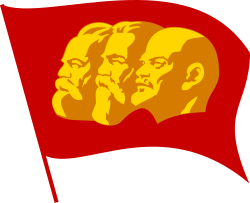
Marx, Engels, and Lenin.
-

Marx, Engels, Lenin, and Stalin.
-
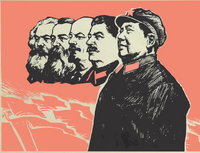
Marx, Engels, Lenin, Stalin, and Mao.
-
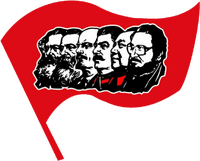
Marx, Engels, Lenin, Stalin, Mao, and Gonzalo.


See also
References
- ↑ Friedrich Engels (1878). Anti-Dühring. Available on the Marxists Internet Archive.
"These two great discoveries, the materialist conception of history and the revelation of the secret of capitalistic production through surplus-value, we owe to Marx. With these discoveries socialism became a science. The next thing was to work out all its details and relations."
- ↑ Joseph Stalin (1924). Foundations of Leninism – Introduction
"Leninism is Marxism of the era of imperialism and the proletarian revolution. To be more exact, Leninism is the theory and tactics of the proletarian revolution in general, the theory and tactics of the dictatorship of the proletariat in particular. Marx and Engels pursued their activities in the pre-revolutionary period (we have the proletarian revolution in mind), when developed imperialism did not yet exist, in the period of the proletarians’ preparation for revolution, in the period when the proletarian revolution was not yet an immediate practical inevitability. But Lenin, the disciple of Marx and Engels, pursued his activities in the period of developed imperialism, in the period of the unfolding proletarian revolution, when the proletarian revolution had already triumphed in one country, had smashed bourgeois democracy and had ushered in the era of proletarian democracy, the era of the Soviets."
"That is why Leninism is the further development of Marxism." - ↑ Lenin and Stalin as Mass Leaders (1939). William Z. Foster.
- ↑ https://redlibrary.info/works/pcp/on-marxism-leninism-maoism.pdf
- ↑ Ragnar Røed (September, 2018). "Why Maoism – What is Maoism?". Tjen Folket. Retrieved April 28, 2025.
"5. Maoism is developed in the first place by six great communist leaders: Marx, Engels, Lenin, Stalin, Mao, and Gonzalo."